 Book Now!
The short answer?
You probably can't.
At least not directly.
I know that's not the answer most people want to hear.
If you've landed on this article, chances are you've already tried. You've shared articles. You've raised concerns. You've pointed out turnover, burnout, disengagement, or communication breakdowns. You've suggested team-building activities, wellness initiatives, employee surveys, or leadership training.
And yet somehow, nothing changes.
The reality is this:
You cannot make someone care about something they don't currently value.
Not your partner.
Not your friend.
Not your teenager.
And not your leader.
But before you close this article in frustration, there is some good news.
While you can't force someone to care about workplace culture, you can dramatically increase the chances that they start paying attention to it.
Let's talk about how.
Most people try to sell culture using culture language.
That sounds reasonable, but it's often where things go wrong.
Consider these statements:
While all of these may be true, they are often interpreted as subjective opinions.
Leaders who don't naturally prioritize culture frequently hear these statements as:
What they often care about instead is:
This is where many culture conversations die before they begin.
Research consistently shows that workplace culture impacts:
The challenge is that leaders rarely wake up thinking:
"I need better culture."
They wake up thinking:
"Why are people leaving?"
"Why are projects delayed?"
"Why are we struggling to hire?"
"Why is innovation slowing down?"
After working with leaders across construction, finance, education, healthcare, and professional services, I've noticed something interesting.
The leaders who care deeply about culture rarely ask, "How do we improve culture?"
Instead, they ask:
Culture is often hiding inside those questions.
The problem is that leaders are usually focused on the symptoms.
Your job is to help connect the dots.
Instead of saying:
"We have a culture problem."
Try:
"Our turnover has increased over the last year. Exit interviews repeatedly mention communication and leadership support."
Or:
"We're seeing increased absenteeism, and our employee survey shows people don't feel comfortable speaking up."
Now you're speaking their language.
.jpg)
Show them performance data.
Show them recruitment challenges, Glassdoor reviews, and employer brand impacts.
Show them the costs of burnout, psychological injury, absenteeism, and turnover.
Show them the actual cost of replacing employees.
Many studies estimate that replacing an employee can cost anywhere from 50% to 200% of their annual salary once recruitment, onboarding, lost productivity, and training are considered.
That tends to get attention.
One of the biggest mistakes culture champions make is proposing massive change.
Most leaders hear:
"We need to transform our culture."
And immediately think:
"That sounds expensive."
Instead, ask for a small experiment.
Examples might include:
A leader may resist a complete overhaul.
They're often far more open to a low-risk experiment.
And sometimes that's all you need to get momentum started.
Sometimes the leader understands the issue.
They just don't care enough to prioritize it.
That's difficult to hear, but important.
Many employees assume leaders don't know.
Often they do know.
They know turnover is high.
They know people are burnt out.
They know trust is low.
The real issue is that they have decided something else matters more.
This is where many people waste years of energy.
Because the challenge is no longer awareness.
It's values.
And values are much harder to change.
This is the question I wish more workplace articles addressed honestly.
What if you've raised concerns?
What if you've brought data?
What if you've suggested solutions?
What if you've had the conversations?
And nothing changes.
At some point, the question shifts from:
"How do I get my leader to care?"
To:
"How long am I willing to stay in an environment where they don't?"
That's a very different conversation.
And often the more important one.
Because while culture is created collectively, individuals have limits.
You can advocate.
You can influence.
You can educate.
But you cannot carry an organization's culture on your shoulders.
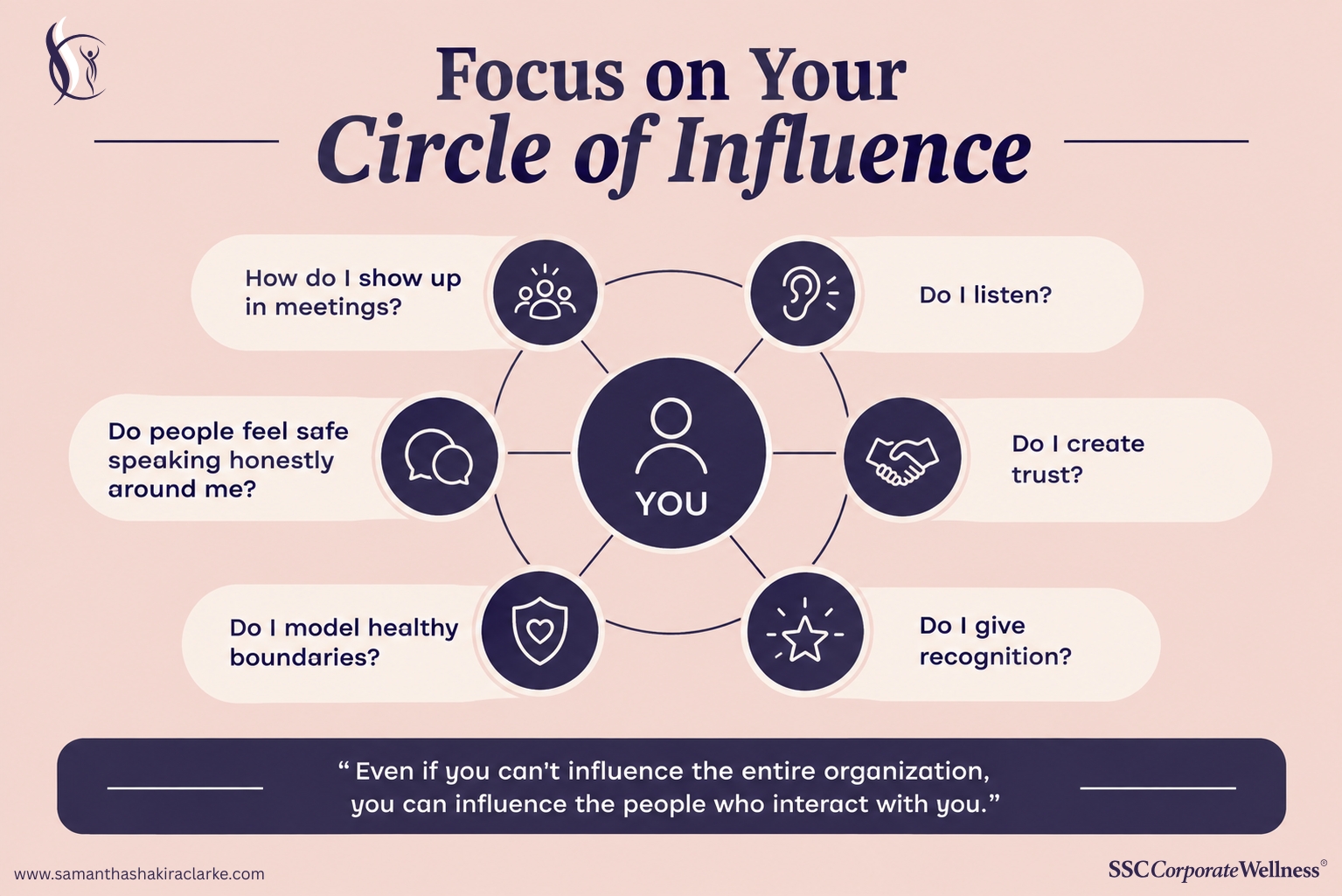
One of the most powerful things you can do is stop trying to change everyone and start strengthening the culture around you.
Ask yourself:
Culture isn't built through mission statements.
It's built through thousands of daily interactions.
It's built through conversations.
Through feedback.
Through recognition.
Through accountability.
Through trust.
Even if you can't influence the entire organization, you can influence the people who interact with you.
Never underestimate the impact of that.
Workplace culture isn't ping-pong tables.
It isn't free snacks.
It isn't wellness weeks.
Culture is what people experience when leadership isn't in the room.
It's the level of trust in a conversation.
It's whether someone feels safe asking for help.
It's whether people leave meetings feeling energized or depleted.
And while you can't force a leader to care about culture, you can help them understand the outcomes culture creates.
Sometimes that works.
Sometimes it doesn't.
The hard truth is that not every leader is ready to listen.
But that doesn't mean you're wrong for caring.
In fact, some of the healthiest organizations I've worked with began because one person was brave enough to keep asking a simple question:
"What kind of workplace are we creating for the people who work here?"
Because ultimately, you can't make someone care about workplace culture.
You can only make it harder for them to ignore the consequences of not caring.


Samantha Shakira Clarke is an established keynote speaker, psycho-somatic coach, and founder of SSC Corporate Wellness—an organization dedicated to bringing mindfulness, nervous system education, and trauma-informed leadership practices into workplaces across North America and beyond.
Her approach bridges neuroscience, somatic psychology, and real-world application—offering sessions that are practical, engaging, and rooted in lived experience. She's worked with Fortune 500 companies, global tech firms, safety organizations, and youth advocacy centres, and is known for creating spaces that feel both human and impactful.


