Why Doing Nothing Can Feel Terrifying for High Performers.



High performers often say they want rest.
Then they get a free afternoon and immediately fill it.
A walk becomes a podcast.
A quiet evening becomes admin.
A holiday becomes a chance to “finally catch up.”
Even rest gets turned into a strategy.
This is not always because high performers love working. Often, it is because doing nothing feels strangely unsafe.
Not physically unsafe.
Psychologically unsafe.
For many high performers, stillness does not feel peaceful at first. It feels exposed.
When there is no task to complete, no problem to solve, no one to help, no next thing to improve, the mind is left alone with itself.
And that can be deeply uncomfortable.
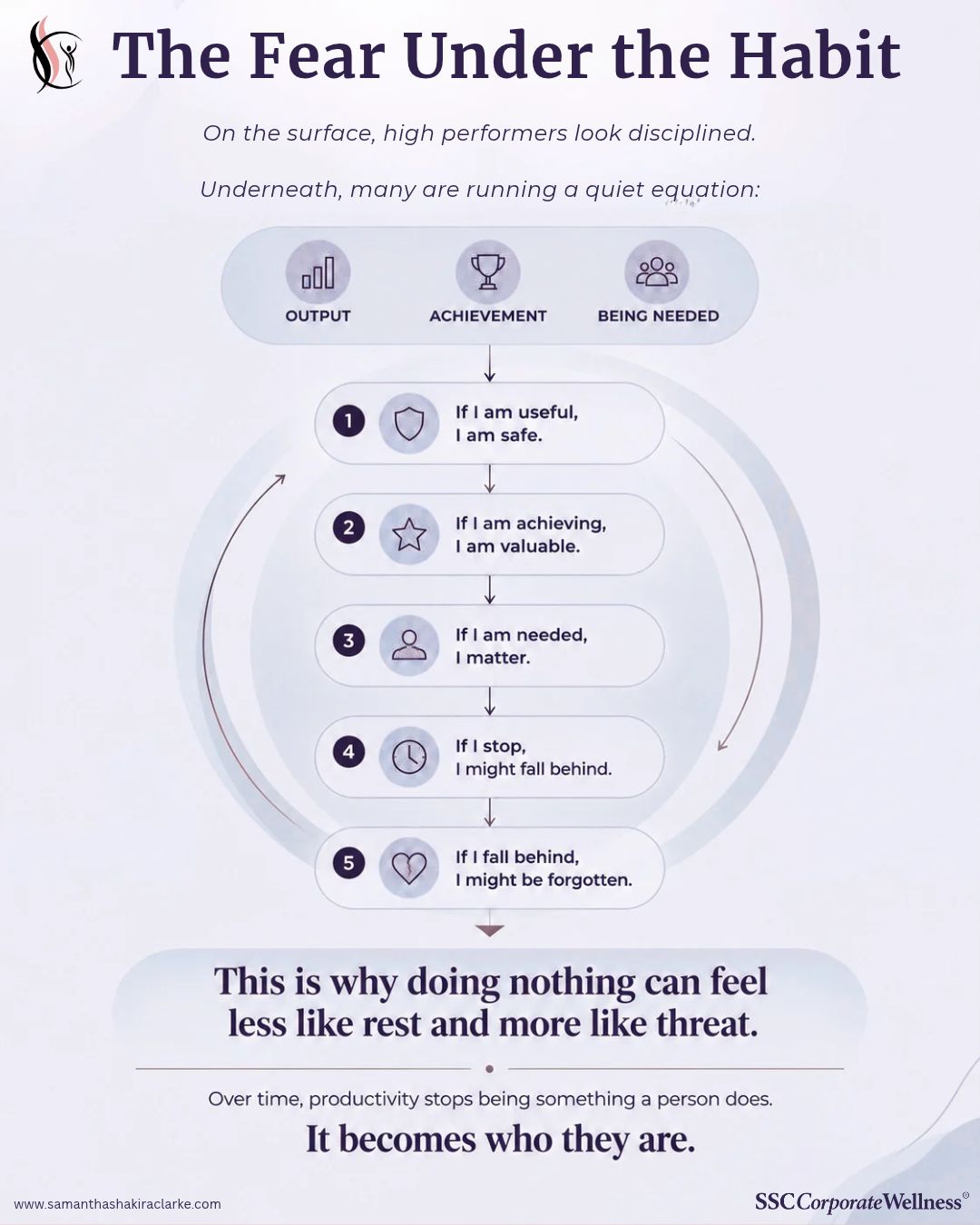
The Fear Under the Habit
On the surface, high performers look disciplined.
Underneath, many are running a quiet equation:
If I am useful, I am safe.
If I am achieving, I am valuable.
If I am needed, I matter.
If I stop, I might fall behind.
If I fall behind, I might be forgotten.
This is why doing nothing can feel less like rest and more like threat.
Not because rest is dangerous, but because the body and brain have learned to associate output with security.
Over time, productivity stops being something a person does.
It becomes who they are.
That is where the trap begins.
Because if achievement becomes identity, rest starts to feel like disappearance.
Why Stillness Feels So Loud
Many people avoid doing nothing because stillness creates space.
And space allows things to surface.
Fatigue.
Loneliness.
Unprocessed emotion.
Dissatisfaction.
Grief.
Questions that have been buried under momentum.
This is one reason busyness can become so addictive. It does not just create results. It creates distance from discomfort.
A full calendar can become a socially acceptable form of avoidance.
No one questions the person who is always busy.
They admire them.
They promote them.
They call them driven.
But constant motion can hide a deeper problem: the inability to be with oneself without a task.
That is not a character flaw.
It is often a learned survival strategy.
The Neuroscience of Never Switching Off
The brain is not designed to be in task mode all day.
Focused work relies heavily on goal-directed attention. This is the part of the mind that plans, prioritizes, organizes, evaluates, and executes.
It is essential.
It is also expensive.
When people move from meeting to email to message to report to notification to meeting, the brain remains locked in a state of external demand.
There is always something to respond to.
Something to assess.
Something to fix.
Something to anticipate.
The issue is not that high performers think too much.
It is that they rarely change mental states.
Rest is not simply the absence of work. Rest is a different mode of brain activity.
When the brain is not focused on an external task, networks associated with memory, imagination, self-reflection, emotional processing, and future thinking become more active.
This is why ideas often arrive in the shower, on a walk, while staring out a window, or just before sleep.
The brain was not doing nothing.
It was integrating.
Doing Nothing Is Not Empty
This is where many high performers misunderstand rest.
They assume that if something does not produce an immediate visible outcome, it is wasted.
But the most important internal work is often invisible.
The brain consolidates.
The body repairs.
The nervous system recalibrates.
Emotions move.
Perspective returns.
Creativity reorganizes.
A person who never stops may appear productive, but they are often operating on increasingly narrow bandwidth.
They can still execute.
They can still perform.
They can still push.
But they may lose access to the very qualities that make leadership sustainable:
Discernment.
Patience.
Creativity.
Humour.
Empathy.
Clear judgment.
The ability to respond rather than react.
Doing nothing is not the opposite of leadership capacity.
It is one of the conditions that allows leadership capacity to return.
The Addiction to Being Needed
There is another layer here that does not get talked about enough.
Many high performers are not only addicted to achievement.
They are addicted to being needed.
Being needed can feel noble. And sometimes it is.
But it can also become a way to avoid the vulnerability of simply existing without proving worth.
This shows up in leaders who cannot delegate.
Managers who answer messages at all hours.
Founders who say they want freedom but build businesses that depend entirely on their exhaustion.
Helpers who give everyone else permission to rest but never take it for themselves.
At some point, “people are relying on me” becomes less of a truth and more of a nervous system pattern.
A familiar role.
A place to hide.
Because being needed gives the mind a job.
And a job can feel safer than stillness.
Why Rest Can Feel Like Withdrawal
When someone is used to constant stimulation, stillness can feel agitating.
Not because rest is wrong.
Because the system is used to a certain level of activation.
Emails, deadlines, praise, pressure, urgency, and achievement all create feedback loops.
They give the brain signals of progress and reward.
Rest does not always provide that same immediate hit.
There is no applause for taking a walk without your phone.
No dopamine spike for staring at the trees.
No performance review for reading fiction.
No gold star for lying on the floor and breathing.
So the high performer often returns to productivity, not because the task matters, but because the state is familiar.
This is why rest has to be practiced.
Not earned.
Practiced.
The Cost of Not Being Able to Stop
If a person cannot rest, they cannot restore.
And if they cannot restore, they will eventually confuse depletion with personality.
They will say:
“I’m just irritable.”
“I’m not creative anymore.”
“I don’t have patience for people.”
“I used to be more inspired.”
“I don’t know why I feel flat.”
“I should be grateful, but I feel nothing.”
Sometimes this is not a motivation problem.
It is a recovery problem.
A system that has been running too hard for too long will eventually protect itself by narrowing.
Less feeling.
Less imagination.
Less tolerance.
Less joy.
Less access to self.
This matters in workplaces because unrested leaders do not just suffer privately.
They shape culture.
A leader who cannot pause often creates a team that cannot pause.
A leader who treats rest as weakness often creates a culture of hidden exhaustion.
A leader who is addicted to urgency will eventually make everything feel urgent.
Even when it is not.
Rest Is Not the Reward for Finishing Everything
One of the great lies of modern work is that rest comes after everything is done.
But everything is never done.
There will always be another email.
Another meeting.
Another improvement.
Another opportunity.
Another person who needs something.
Another reason to wait.
If rest is only allowed after completion, rest will always be postponed.
High performers need a different relationship with recovery.
Not rest as a reward.
Rest as maintenance.
Rest as responsibility.
Rest as a leadership practice.
Rest as the thing that protects the quality of the work, the clarity of the mind, and the humanity of the person doing it.
What Doing Nothing Actually Builds
Doing nothing builds tolerance for space.
It teaches the body that stillness is not danger.
It teaches the mind that worth does not disappear in the absence of output.
It allows creativity to emerge without being forced.
It allows emotion to move without being managed.
It allows the person underneath the performance to come back into view.
This is not laziness.
This is capacity building.
The kind that does not look impressive on a calendar.
The kind that may not produce a deliverable by 3 p.m.
The kind that makes someone a better leader because they are no longer leading from constant depletion.
The Real Question
The question is not whether high performers deserve rest.
Of course they do.
The deeper question is:
Why does doing nothing feel so threatening in the first place?
Because until that question is answered, rest will keep being scheduled and sabotaged.
Planned and postponed.
Desired and avoided.
The work is not just learning how to rest.
The work is learning how to feel safe when nothing is being achieved.
That is where recovery begins.
Not when the inbox is empty.
Not when the project is finished.
Not when everyone else is okay.
Recovery begins when a person can stop performing long enough to remember they are still allowed to exist.

Turn the science into a shared practice.