 Book Now!
There's a moment most executives hit, usually somewhere between the promotion they fought for and the role they were certain they were ready for, where they realize something quietly unsettling: there is no one above them anymore. No clear playbook. No manager to debrief with after the hard call. The room they used to look up to is now the room they walk into.
It's a strange kind of lonely. And it's exactly the moment most leaders start to wonder if they need a mentor.
The short answer is yes. The longer answer is more interesting, because mentorship at the executive level looks almost nothing like the mentorship most people picture.
At its simplest, mentorship is a relationship where someone with more experience in a particular area guides someone with less. It is not coaching, not therapy, and not management. A mentor shares perspective, asks sharper questions than you would think to ask yourself, and offers a kind of pattern recognition that only comes from having been there before.
.jpg)
What it is not is a coffee chat once a quarter where someone tells you how great you are doing. That is a fan club. A real mentor is the person who, with care, tells you the thing nobody else in your professional life is positioned to tell you.
The higher you climb, the thinner the air gets when it comes to honest feedback. Your direct reports often soften their words. Your peers may be quietly competing with you. Your board sees a curated version of you. Your friends and family love you but cannot always speak to the specifics of running a leadership team or navigating a complex restructure.
A Sun Microsystems internal study famously found that employees with mentors were promoted five times more often than those without. That stat tends to circulate in early-career circles, but the underlying mechanism is even more important at the top: mentorship compresses learning. Executives who have one are not smarter, they just have access to lived wisdom that would otherwise take years to accumulate on their own.
Without a mentor, executives tend to:
That last one is the quiet killer. Leadership growth stalls the moment self-awareness stops growing.
There is a romantic idea floating around that you find your mentor by destiny. A wise older figure spots your potential, takes you under their wing, and the rest is history. It is a lovely story. It is also not how it usually goes.
Good executive mentorship tends to share a few traits:
1. The mentor is genuinely a step or two ahead, not ten. Someone who has just navigated the thing you are facing remembers what it felt like in their body. A mentor who is decades removed sometimes offers wisdom that has aged out of relevance. Both can be useful, but proximity to your stage matters more than people think.
2. The relationship has rhythm. Mentorship that survives is usually structured, even loosely. A standing call every six weeks, a quarterly lunch, a Voxer thread that pings back and forth. Without rhythm, the relationship slowly evaporates the moment things get busy.
3. There is mutual respect, not hierarchy. The mentor is not above you. They are alongside you, looking at your situation from a different angle. The best executive mentors treat the relationship as a two-way street, often learning from the mentee's fresh perspective, energy, or industry context.
4. There is room for the unflattering parts. If you can only bring your polished self to your mentor, the relationship will not change your life. The whole point is to have somewhere safe to bring the messy decision, the conflict you handled badly, the doubt you cannot voice in your exec team. Without that, you are networking, not being mentored.
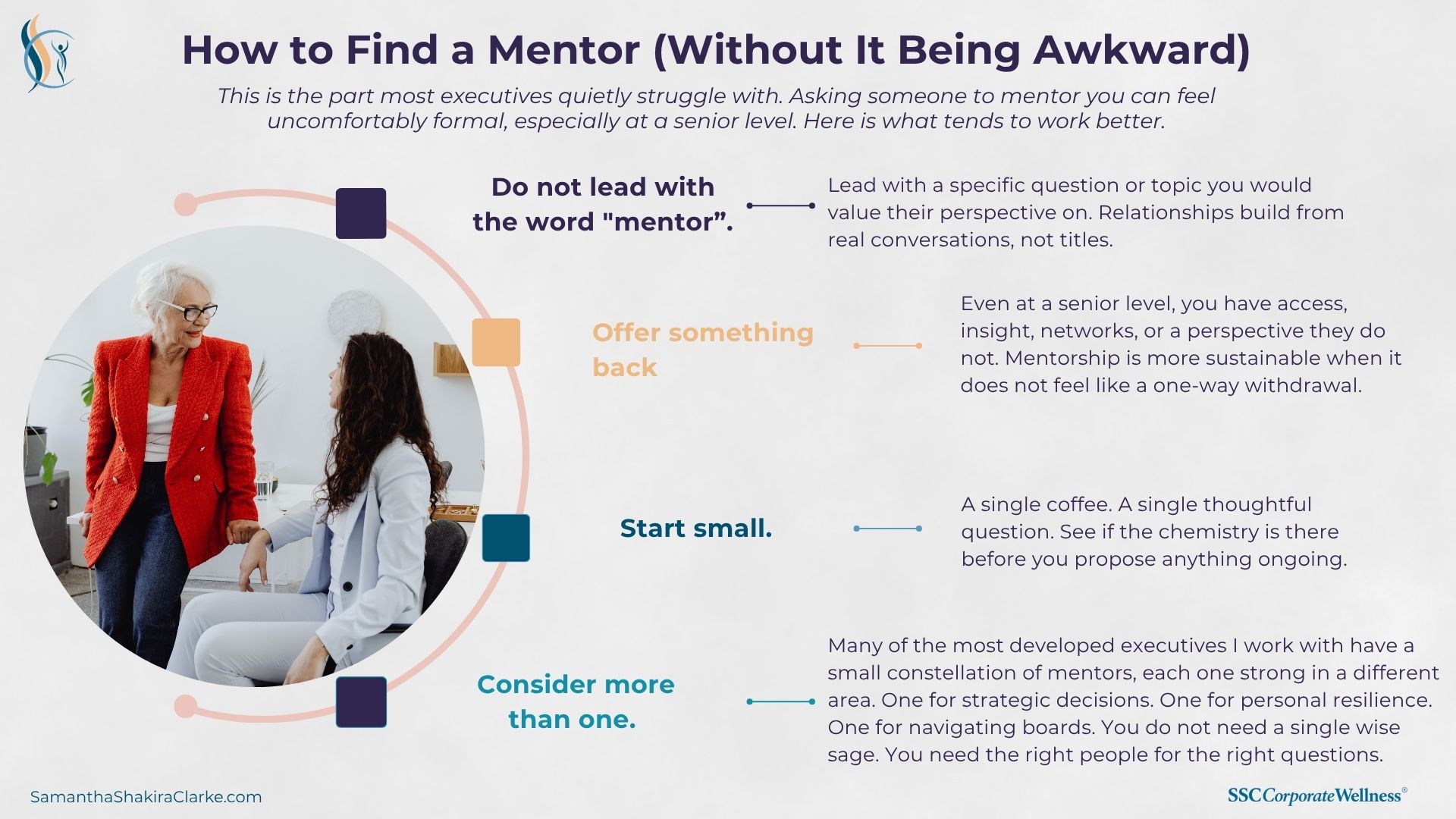
These two get blurred together constantly, and they are not the same thing.
A mentor shares their lived experience and offers advice from a place of "here is what I would do, and here is what I learned." A coach, especially an executive coach, generally does not give advice. A coach helps you access your own clarity through structured questioning, somatic awareness, and reflection. The mentor pulls from their map. The coach helps you draw yours.
The leaders who develop the fastest usually have both. A mentor for the wisdom of someone who has walked the path, and a coach for the deeper internal work of becoming the leader the next chapter is asking you to be.
Executive development is not just about acquiring more skills. At a certain point, every senior leader hits a ceiling that cannot be broken through with another course, certification, or framework. The next layer of growth is almost always relational, reflective, and deeply personal.
Mentorship is one of the most underused levers for that kind of growth. It is not a sign that you do not know what you are doing. It is a sign that you are serious about doing it well.
If you have been carrying a lot alone at the top, or if you are coaching executives in your organization and want to build a real culture of mentorship and development around them, let's talk. I work with senior leaders and leadership teams to build the kind of internal capacity, self-awareness, and support structures that make executive growth sustainable rather than exhausting.


Samantha Shakira Clarke is an established keynote speaker, psycho-somatic coach, and founder of SSC Corporate Wellness—an organization dedicated to bringing mindfulness, nervous system education, and trauma-informed leadership practices into workplaces across North America and beyond.
Her approach bridges neuroscience, somatic psychology, and real-world application—offering sessions that are practical, engaging, and rooted in lived experience. She's worked with Fortune 500 companies, global tech firms, safety organizations, and youth advocacy centres, and is known for creating spaces that feel both human and impactful.


