 Book Now!
There’s a kind of tired that sleep doesn’t fix.
It’s the exhaustion that comes from waiting, from not knowing what’s next.
For the past few weeks, I’ve noticed that minor stressors have affected me more deeply than usual. Little pieces of feedback have stuck harder. Small tasks have felt heavier. I kept wondering why. Then I realised it might have something to do with the house, the one I’m trying to sell, the one that hasn’t sold yet, and the one we’re hoping to buy.
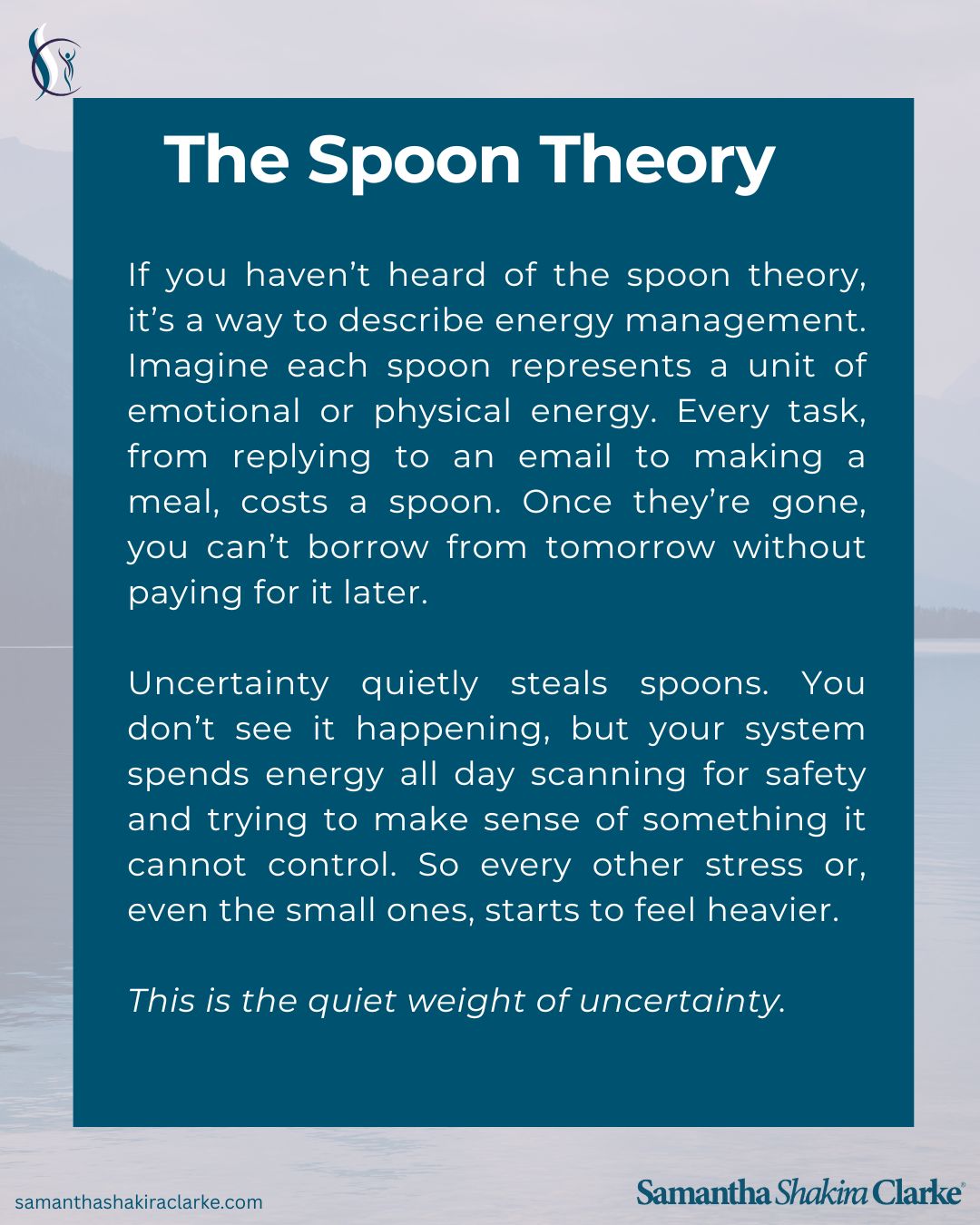
I couldn’t quite name it at first, but I could feel it. My energy each day felt limited, like I had fewer spoons to work with.
Our nervous system evolved to handle short bursts of threat, not the slow, drawn-out uncertainty of modern life.
When we don’t know what’s coming, the body doesn’t simply wait. It prepares.
Heart rate shifts subtly. Muscles stay slightly tense. The mind scans for signs. You might not feel panicked, but your system is running a low-grade stress response, a steady drip of adrenaline and cortisol keeping you ready.
Neuroscientists Bruce McEwen and Eliot Stellar called this cumulative strain allostatic load, the wear and tear that builds up when our body constantly adjusts to stress. Over time, this ongoing activation taxes every system of the body, from digestion and immunity to sleep and emotional regulation.
Research from the American Psychological Association shows that uncertainty activates the same stress pathways as physical threat. Brain imaging studies also reveal that ambiguity lights up the amygdala and anterior cingulate cortex, regions designed to detect danger and predict outcomes. In other words, your nervous system treats “not knowing” as an active threat.
Failure gives the brain closure. It’s painful, but it’s done.
Uncertainty is open-ended, and the human brain is wired to find unfinished loops intolerable. Psychologists call this the need for cognitive closure. When closure is missing, the brain keeps scanning for answers, even when there are none yet.
That’s why, while you’re waiting for an outcome, everything else in life can start to feel bigger, harder, louder. Your bandwidth is already being used up managing an invisible threat.
Cognitively, you might say, “I’m fine, I’ve got a plan.”
But your body isn’t convinced. It’s running on ancient software that links safety to control. So while your logical mind organizes logistics, your feeling body hums with low-level alarm.
This mismatch between the thinking brain and the feeling body is often the source of modern burnout. We override the body’s signals with productivity until it forces us to stop.
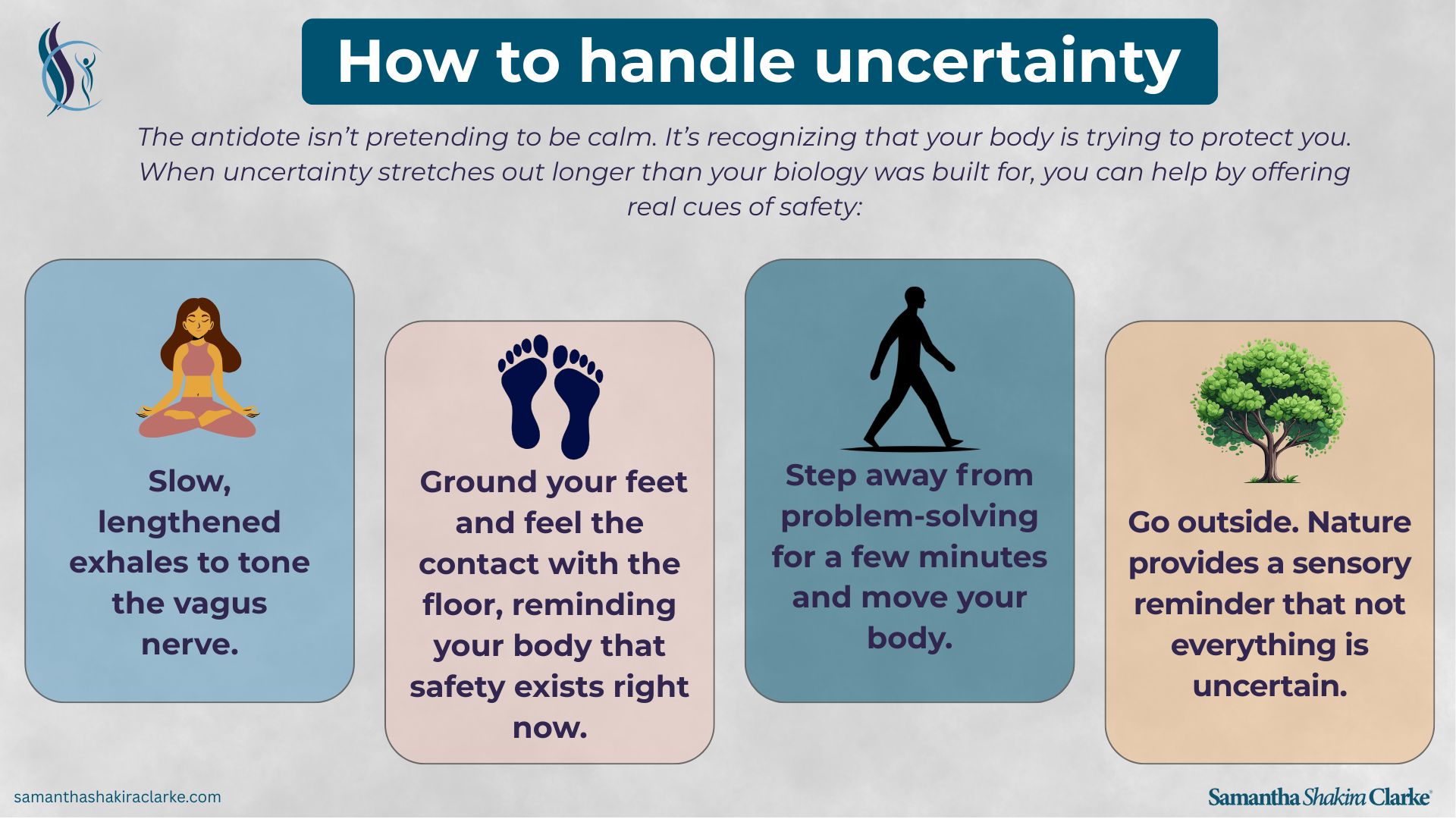
You can’t think your way out of uncertainty, but you can feel your way through it.
Sometimes what drains us isn’t the big event itself. It’s the waiting. The not knowing. The nervous system quietly holding vigil, hoping to keep us safe.
When everything feels heavy, it might not be that you’re weak or failing to cope. It might just be that your body is doing its best to manage the quiet, invisible work of uncertainty.


Samantha Shakira Clarke is an established keynote speaker, psycho-somatic coach, and founder of SSC Corporate Wellness—an organization dedicated to bringing mindfulness, nervous system education, and trauma-informed leadership practices into workplaces across North America and beyond.
Her approach bridges neuroscience, somatic psychology, and real-world application—offering sessions that are practical, engaging, and rooted in lived experience. She's worked with Fortune 500 companies, global tech firms, safety organizations, and youth advocacy centres, and is known for creating spaces that feel both human and impactful.


