 Book Now!
Conflict in the workplace is inevitable, especially at the executive level where decisions carry high stakes, competing priorities, and strong personalities. However, strong leaders do not avoid conflict. Instead, they manage it with clarity, emotional intelligence, and structure. When handled well, conflict can actually improve innovation, trust, and team performance. When handled poorly, it leads to disengagement, poor communication, and organizational dysfunction. Therefore, learning conflict resolution is not just a soft skill for leaders. It is a core leadership competency that directly impacts culture, performance, and retention.
This is exactly where structured leadership support, such as executive coaching at SSC Corporate Wellness, can help leaders build practical conflict resolution skills early on.
Conflict resolution is the process of addressing disagreements in a constructive way that leads to understanding, agreement, or productive compromise. It focuses on solving the problem rather than winning the argument.
In leadership, conflict resolution involves listening to all perspectives, identifying the root cause of disagreement, managing emotions, and guiding people toward a solution that supports both relationships and business goals. Effective conflict resolution does not mean avoiding tension or forcing agreement. Instead, it means creating an environment where disagreements can be discussed openly, respectfully, and productively.
When leaders understand conflict resolution, conflict becomes a tool for improvement rather than a threat to team stability.
Conflict resolution is critical for leaders because unresolved conflict reduces productivity, damages trust, and creates communication breakdowns across teams. Leaders set the tone for how conflict is handled in an organization.
Research from organizational psychology shows that employees spend several hours per week dealing with conflict, which significantly impacts productivity and morale. When leaders avoid conflict, small issues often grow into major organizational problems. However, when leaders address conflict early and effectively, teams build trust and psychological safety.
This is closely connected to empathy-based leadership and mental health awareness. Leaders who understand emotional dynamics manage conflict more effectively. You can explore this further in this article on mental health leadership skills and empathy in management.
Workplace conflict rarely happens because people simply dislike each other. Most conflict is caused by structural or communication issues within the organization.
Common causes include unclear roles, communication breakdowns, competing priorities, personality differences, and resource limitations. Misalignment between departments is also a major cause of conflict, especially in larger organizations where teams operate in silos.
Many conflicts are actually misunderstandings rather than true disagreements. This is why communication and emotional intelligence are two of the most important leadership skills for conflict resolution.
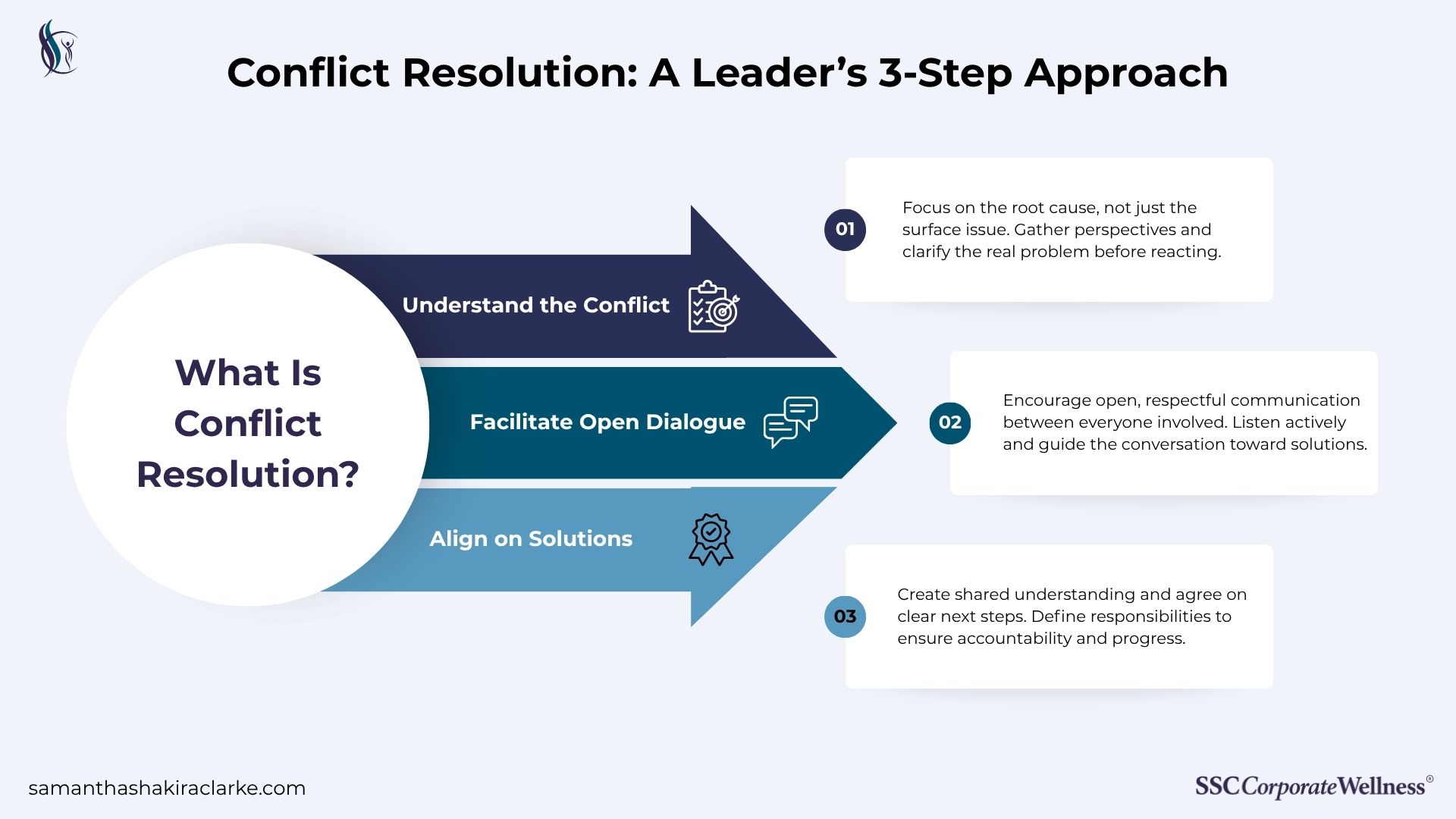
Active listening is one of the most important conflict resolution skills because people want to feel heard before they are willing to collaborate on a solution. Leaders must listen to understand rather than listen to respond.
Active listening involves asking clarifying questions, summarizing what the other person said, and acknowledging their perspective. When people feel heard, defensiveness decreases and problem solving becomes easier.
Emotional intelligence allows leaders to manage their own emotions while also recognizing the emotions of others. Conflict often escalates because emotions are ignored or misunderstood.
Leaders with high emotional intelligence remain calm during disagreements, identify emotional triggers, and guide conversations toward productive outcomes instead of emotional reactions.
Clear communication prevents many conflicts before they even start. Leaders must communicate expectations, roles, decisions, and feedback clearly and directly.
Indirect communication often leads to assumptions, confusion, and frustration, which eventually turn into conflict. Clear communication reduces misunderstandings and improves accountability across teams.
Empathy helps leaders understand why someone feels frustrated, defensive, or resistant during conflict. Perspective taking does not mean agreeing with someone. It means understanding their viewpoint before making a decision.
This leadership skill is also connected to self-awareness and personal development. Leaders who understand their own emotional patterns and past experiences often manage conflict more effectively. This concept is explored in this leadership development article on self awareness and inner child work in leadership.
Conflict resolution ultimately requires problem solving. Leaders must move conversations from blame to solutions.
Strong leaders identify shared goals, explore multiple solutions, and guide teams toward compromise or collaboration. Negotiation is not about winning. It is about finding a solution that allows work to move forward while maintaining professional relationships.
Many workplace conflicts are caused by assumptions rather than facts. Leaders must learn to question their own biases and encourage teams to clarify assumptions before reacting.
When leaders focus on facts instead of interpretations, conflict conversations become more objective and less emotional.
Leaders can use structured strategies to manage conflict effectively rather than reacting emotionally in the moment.
Some proven conflict resolution strategies include:
These strategies help leaders keep conflict productive and prevent long-term relationship damage within teams.
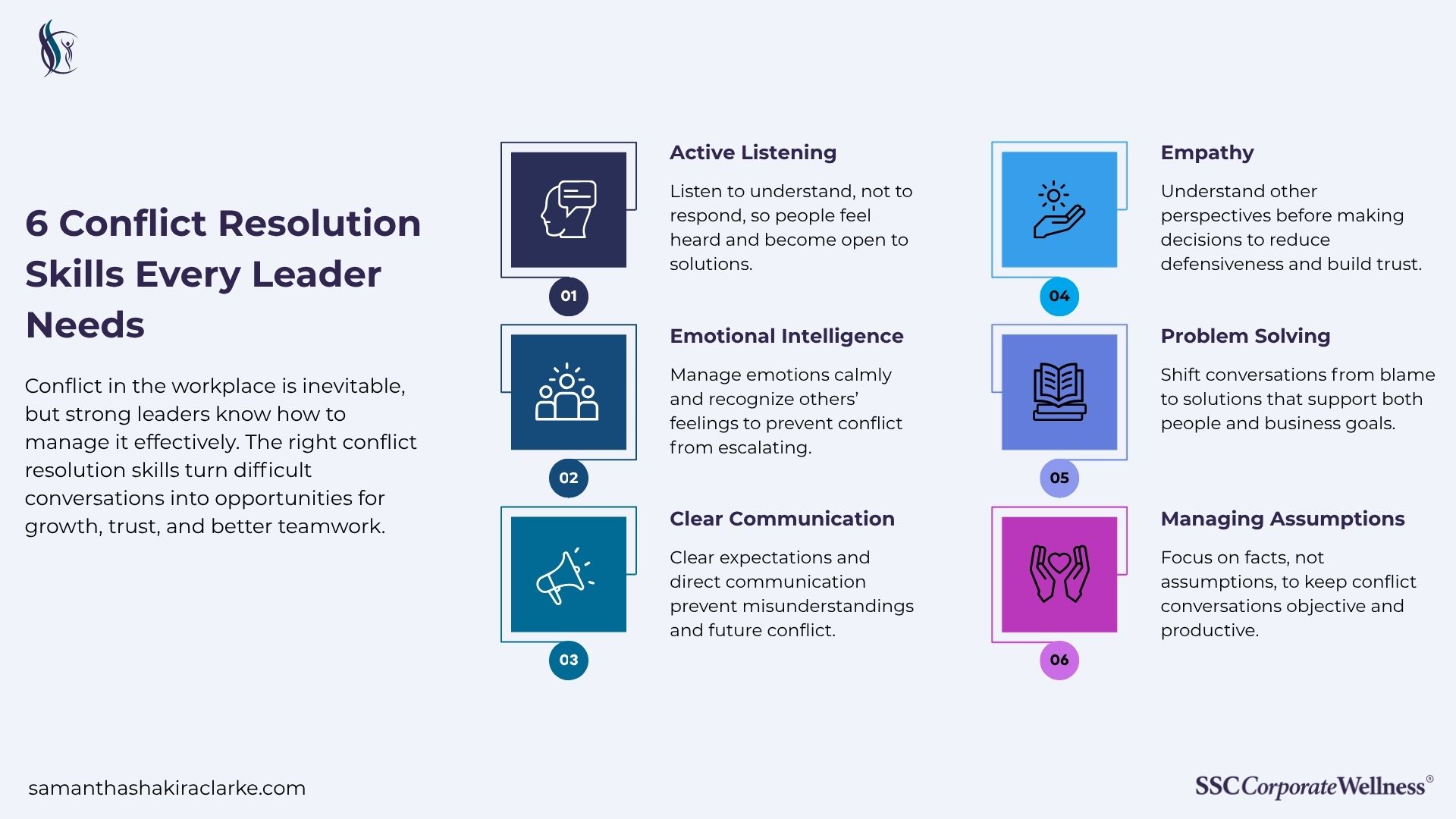
Leaders can follow a simple process to handle workplace conflict in a structured and professional way.
First, understand the issue by speaking to each person involved and listening to their perspective. Second, identify the root cause of the conflict rather than focusing only on the surface problem. Third, bring the parties together to discuss solutions and shared goals. Finally, agree on clear next steps and follow up to ensure the conflict is resolved.
This structured approach prevents emotional reactions and keeps the conversation focused on solutions and accountability.
This type of conflict usually comes from communication issues, personality differences, or unclear responsibilities. Leaders should meet with both individuals, clarify expectations, and help them agree on communication and workflow processes moving forward.
This conflict often comes from feedback, performance expectations, or communication style differences. Leaders should focus on clarity, expectations, and mutual understanding rather than authority and hierarchy.
This is very common in organizations where departments have different goals or priorities. Leaders should align teams around organizational goals, clarify responsibilities, and improve communication between departments.
Leaders can improve conflict resolution skills through self awareness, communication training, feedback, and leadership coaching. Like any leadership skill, conflict resolution improves with practice and reflection.
Ways to improve include:
Leaders who actively work on communication and emotional intelligence become significantly more effective at managing conflict over time.
Executive coaching helps leaders improve self awareness, emotional intelligence, communication skills, and decision making, all of which are essential for conflict resolution.
Coaches help leaders identify communication patterns, emotional triggers, leadership blind spots, and conflict management styles. With coaching, leaders learn structured approaches to difficult conversations and conflict situations, which improves leadership effectiveness and organizational culture.
Executive coaching is especially valuable for senior leaders because conflict at the executive level often involves strategy, organizational change, and high stakes decision making.
Conflict is not a leadership problem to avoid. It is a leadership responsibility to manage. Leaders who develop conflict resolution skills build stronger teams, better communication, higher trust, and healthier workplace cultures. Conflict, when handled correctly, leads to innovation, clarity, and stronger relationships.
Executive leaders who invest in communication, emotional intelligence, empathy, and structured conflict resolution strategies become more effective decision makers and more respected leaders. In modern organizations, conflict resolution is not optional. It is one of the most important leadership skills for long term organizational success.
If you are ready to strengthen your leadership impact and confidently handle workplace conflict, connect with SSC Corporate Wellness via email team@samanthashakiraclarke.com or book a discovery call to explore executive coaching and leadership development programs tailored to your organization.


Samantha Shakira Clarke is an established keynote speaker, psycho-somatic coach, and founder of SSC Corporate Wellness—an organization dedicated to bringing mindfulness, nervous system education, and trauma-informed leadership practices into workplaces across North America and beyond.
Her approach bridges neuroscience, somatic psychology, and real-world application—offering sessions that are practical, engaging, and rooted in lived experience. She's worked with Fortune 500 companies, global tech firms, safety organizations, and youth advocacy centres, and is known for creating spaces that feel both human and impactful.


