 Book Now!
If you’ve ever stepped outside in the middle of a grey, soul-soaking Vancouver winter and felt your whole body whisper, “Thank god… light,” you’re not imagining it. Even two minutes of winter sun on your face can make you feel more alive. And it’s not placebo, even if the vitamin D part is basically a write-off this time of year.
Let’s break it down in a way that feels honest and grounded.
This is the part nobody wants to hear, but it’s true.
From roughly October to March in northern latitudes, the sun sits too low in the sky for UVB rays to penetrate the atmosphere. UVB is the wavelength required for your skin to synthesize vitamin D. Without it, you’re basically a solar panel pointed the wrong way.
So if you’re hoping your five minutes of winter sun exposure is topping up your vitamin D levels, it’s not.
But that doesn’t mean the sun is useless.
Far from it.
When sunlight hits receptors in your eye, it sends signals straight to your hypothalamus. This isn’t the seeing part of the brain – it’s the regulating part.
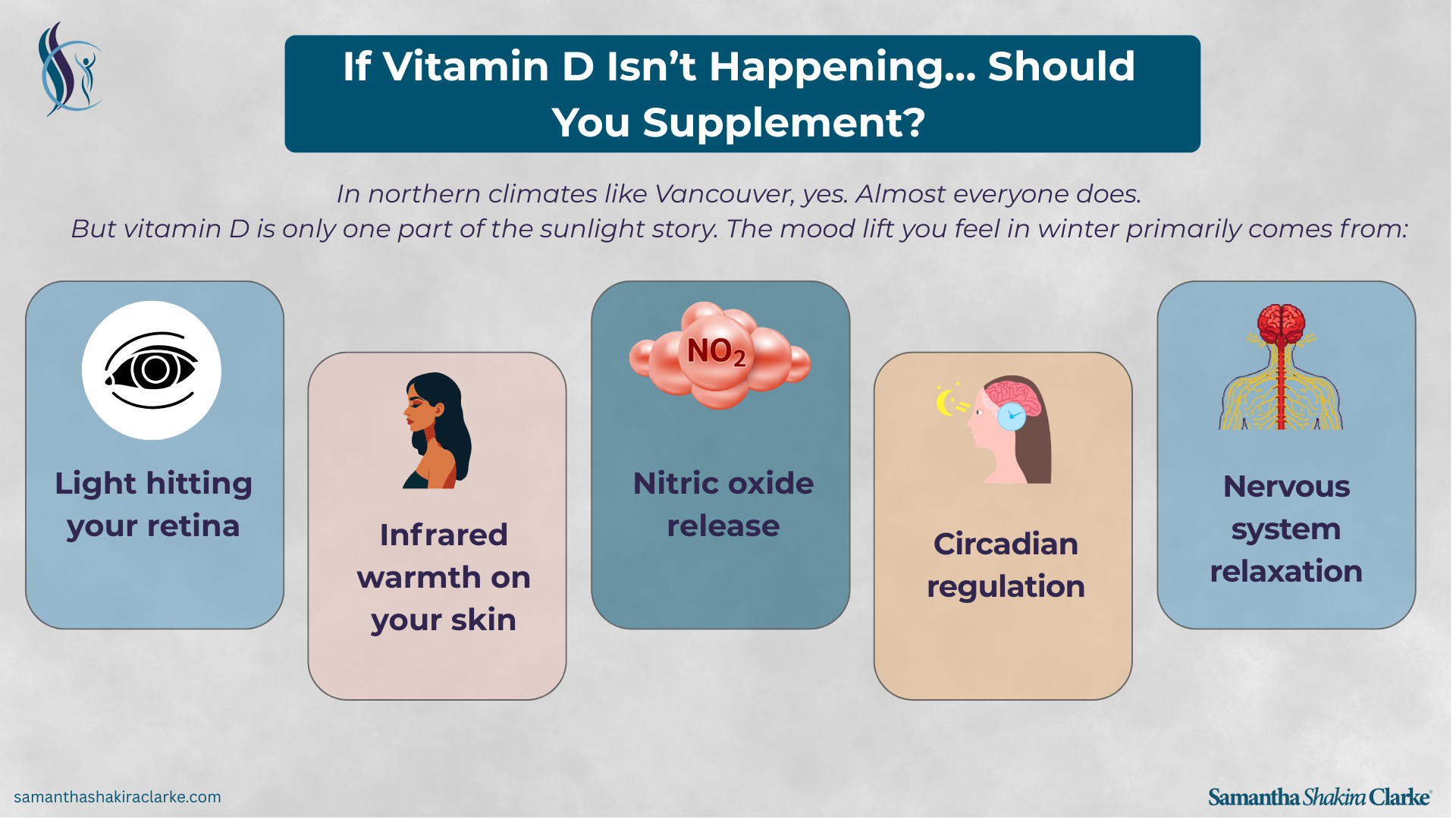
The benefits you feel have almost nothing to do with vitamin D and everything to do with the way light interacts with your nervous system, brain chemistry, and skin.
1. Visible Light Directly Boosts Your Mood
This one hit of light begins:
You’re not imagining the shift. Your brain is literally recalibrating.
2. Sunlight Resets Your Circadian Rhythm
Your internal clock needs a clear “daytime” signal to run properly. In winter, with endless cloud cover and late sunrises, your clock drifts. Your body basically thinks it’s living inside a cave.
Even a short burst of real sunlight is enough to anchor your rhythm again.
When your clock is synced, everything improves:
It’s why winter sun feels like someone switched your system back on.
3. Infrared Light Relaxes the Body
Even weak winter sun carries infrared radiation. You feel it as a gentle warmth on the skin, but inside the body it’s doing more.
Infrared light:
It’s a physiological exhale.
4. UVA Triggers Nitric Oxide Release
This part is wild but real.
Skin cells release nitric oxide when exposed to UVA light. Nitric oxide:
That quick, warm, “softening” feeling you get in your chest? That’s biology.
5. Light Changes Your Brain’s Electrical Activity
Sunlight increases alpha brain waves, which are associated with calm alertness. Winter darkness pushes many people into beta overload – the anxious, buzzy, wired state.
Light nudges your brain back into a more stable rhythm.
6. Psychological and Evolutionary Signals
Your nervous system carries an ancient truth:
Sunlight means safety, warmth, food, community.
Darkness means conserve energy, be vigilant, stay close to shelter.
This is why even a sliver of sunshine doesn’t just brighten the world; it brightens your internal landscape.
Not even remotely.
Placebo relies on belief.
Sunlight relies on physics, biology, and a few million years of evolution.
What you feel is your body recognizing the world again.
None of that requires strong UVB. It just requires daylight.
Because the body is exquisitely sensitive to light cues.
When you’ve been living in dim conditions, even a tiny moment of brightness gives your nervous system something to orient around.
It’s like opening a window in a stale room.
Winter sunlight may not make vitamin D, but it absolutely makes a difference. It wakes up your brain, steadies your nervous system, and gives your body a dose of the one thing it’s built to respond to: natural light.
It’s not placebo.
It’s biology.
And your body knows the difference.


Samantha Shakira Clarke is an established keynote speaker, psycho-somatic coach, and founder of SSC Corporate Wellness—an organization dedicated to bringing mindfulness, nervous system education, and trauma-informed leadership practices into workplaces across North America and beyond.
Her approach bridges neuroscience, somatic psychology, and real-world application—offering sessions that are practical, engaging, and rooted in lived experience. She's worked with Fortune 500 companies, global tech firms, safety organizations, and youth advocacy centres, and is known for creating spaces that feel both human and impactful.


